RTD Tea Production Process: From Tea Extraction to Hot Filling

What is Ready-to-Drink (RTD) Tea?

With growing health awareness and increasingly fast-paced lifestyles, Ready-to-Drink (RTD) tea has become one of the fastest-growing beverage categories worldwide. Compared with traditional loose-leaf tea or tea bags, RTD tea is fully brewed, packaged, and ready for immediate consumption. It offers consumers a convenient, safe, and consistent beverage while preserving the natural flavor and beneficial compounds of tea.

Today, RTD tea products include green tea, black tea, oolong tea, white tea, herbal tea, fruit tea, and functional tea beverages. Depending on market demand, manufacturers can formulate products with fruit juice, honey, plant extracts, vitamins, and other functional ingredients to develop low-sugar, sugar-free, high-fiber, or health-oriented beverages.

Driven by the increasing demand for natural ingredients and clean-label products, more beverage manufacturers are replacing artificial flavor formulations with direct tea leaf extraction technology. This approach helps preserve the natural aroma, color, and bioactive compounds of tea while enhancing product quality and market competitiveness.

kombucha fermenter July eight 1

RTD Tea Production Process

The primary objective of RTD tea production is to maximize the retention of tea’s natural flavor, color, and nutritional components while ensuring food safety, product consistency, excellent taste, and an extended shelf life.

A complete RTD tea production line typically includes the following processing steps:

Raw Material Preparation → Tea Extraction → Coarse Filtration → Cooling → Centrifugal Clarification → Blending → Homogenization (Optional) → Vacuum Deaeration → UHT Sterilization → Hot Filling → Cooling → Packaging

The entire production process is automatically controlled to precisely manage temperature, processing time, flow rate, and ingredient dosing, ensuring consistent product quality from batch to batch.

1. Raw Material Preparation

High-quality raw materials are the foundation of premium RTD tea production.

Natural tea leaves such as green tea, black tea, oolong tea, white tea, and herbal tea are selected as the primary ingredients. Purified water that meets food processing standards is used throughout production. Depending on the product formulation, ingredients such as sugar, citric acid, vitamins, and natural flavors may be added to achieve the desired taste and nutritional profile.

Processing water typically passes through quartz sand filtration, activated carbon filtration, water softening, and reverse osmosis (RO) treatment to ensure stable water quality and reliable product consistency.

2. Tea Extraction

Tea extraction is the most critical step in determining the flavor and quality of RTD tea.

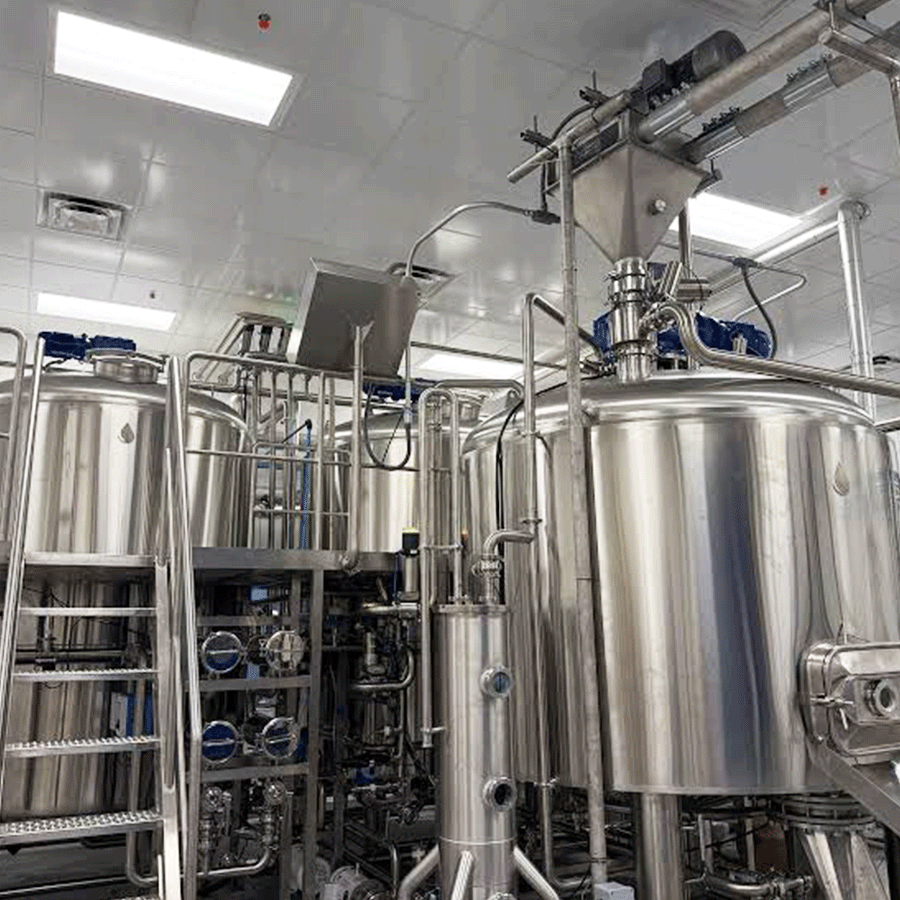
Measured quantities of tea leaves are transferred into an automated tea extraction tank, where extraction temperature and brewing time are carefully controlled to maximize the release of tea polyphenols, amino acids, caffeine, and aromatic compounds while minimizing excessive bitterness.

Typical extraction temperatures include:

Green Tea: 75–85°C
Oolong Tea: 80–90°C
Black Tea: 90–95°C
Herbal Tea: Adjusted according to the characteristics of each botanical ingredient

Automated circulating extraction systems improve extraction efficiency and ensure consistent tea flavor across production batches.

kombucha fermenter July eight 2

3. Tea Filtration and Clarification

After extraction, the tea liquor contains tea particles, fibers, and suspended solids that must be removed.

The tea first passes through a coarse filtration stage to remove large particles, followed by centrifugal clarification to eliminate fine suspended solids and produce a clear tea infusion. This process improves product appearance, reduces sediment formation during storage, and enhances overall product stability.

4. Tea Cooling

The clarified tea is rapidly cooled to approximately 45–60°C using a plate heat exchanger before entering the blending stage.

Rapid cooling minimizes oxidation of tea polyphenols and reduces the loss of volatile aroma compounds, helping preserve the tea’s natural color and fresh flavor.

5. Ingredient Blending

The cooled tea is transferred to a blending tank, where purified water and other ingredients—including sugar syrup, fruit juice, natural flavors, acidity regulators, and plant extracts—are automatically dosed and thoroughly mixed according to the product formulation.

The blending process is carried out in a closed mixing system. Some production lines also utilize nitrogen or carbon dioxide protection to minimize oxygen exposure, helping maintain the tea’s natural color and flavor.

6. Homogenization (Optional)

For RTD tea formulations containing fruit juice, dairy ingredients, plant proteins, or other functional components, high-pressure homogenization is recommended.

Homogenization reduces particle size, improves product stability, prevents phase separation or sedimentation, and provides a smoother mouthfeel. Pure tea beverages generally do not require homogenization and can bypass this step depending on the product formulation.

7. Vacuum Deaeration

Dissolved oxygen accelerates oxidation of tea polyphenols, leading to color changes, flavor deterioration, and reduced shelf life.

Vacuum deaeration removes dissolved oxygen before sterilization, preserving the tea’s natural flavor while improving product stability and extending shelf life.

8. UHT Sterilization

Since most RTD tea beverages are classified as low-acid products (typically with a pH above 4.6), Ultra-High Temperature (UHT) sterilization is widely used.

The tea beverage is rapidly heated to approximately 127–135°C for several seconds, effectively eliminating bacteria, yeast, and mold while minimizing the loss of natural flavor and nutritional components.

Combined with hot filling technology, UHT sterilization achieves commercial sterility without the need for artificial preservatives, allowing long-term ambient storage.

9. Hot Filling and Packaging

After sterilization, the tea beverage is filled into PET bottles at approximately 84–88°C and immediately sealed with sterilized caps.

The residual heat inside the bottle further sterilizes the bottle neck and cap before the bottles enter a cooling tunnel, where they are gradually cooled to prevent PET bottle deformation while maintaining product quality.

After cooling, the bottles pass through automatic drying, labeling, date coding, case packing, and palletizing systems before entering storage and distribution. The finished products are then delivered to supermarkets, convenience stores, e-commerce platforms, restaurants, and other retail channels.

As consumer demand continues to grow for natural, low-sugar, and functional tea beverages, RTD tea manufacturing is evolving toward greater automation, intelligence, and product quality.

티안타이 provides complete turnkey RTD tea production line solutions tailored to customers’ product types, production capacities, packaging formats, and automation requirements. Our services cover process design, equipment manufacturing, installation, commissioning, and technical training.

Whether for laboratory-scale development, pilot production, or large-scale industrial manufacturing, our customized solutions help customers build efficient, reliable, and intelligent RTD tea production facilities.

여러분의 의견을 듣고 싶습니다.

콤부차 프로젝트에 대해 알려주시면 더 빠르게 도움을 드릴 수 있습니다.

문의 양식 데모

연락하기

다음 프로젝트를 지원할 파트너를 찾고 계신가요? Tiantai는 혁신적인 프로세스 설계, 엔지니어링, 시공 및 장비 선택 서비스를 제공하고자 합니다. 예정된 프로젝트에 대해 자세히 알려주시면 도움을 드릴 수 있습니다.

전문가 팀이 언제나 여러분을 도와드립니다. 티안타이는 우수한 고객 서비스를 제공하고 제품 및 서비스에 대한 만족을 보장하기 위해 최선을 다하고 있습니다.

위로 스크롤