
Fruit, juice, herbs, and spices have become an important part of commercial kombucha production.
They allow producers to create new flavor profiles from the same fermented tea base and give brands considerable room for product development. But adding a flavoring ingredient is not simply a matter of choosing a fruit and mixing it into the kombucha.
The timing of the addition matters.
Add fruit juice too early, and the extra sugars and nutrients can change the primary fermentation. Add it too late, and the flavor may not integrate as expected. Add a highly aromatic herb or spice at the wrong stage, and the desired volatile compounds may be lost or overshadowed by the fermentation profile.
For commercial producers, flavoring should therefore be treated as part of the fermentation and processing strategy.
The most common options are:
- Adding flavor ingredients during primary fermentation
- Adding them after primary fermentation
- Adding them during secondary fermentation or conditioning
The best choice depends on whether the producer wants the ingredients to participate in fermentation or simply contribute flavor and aroma to an already-fermented kombucha base.
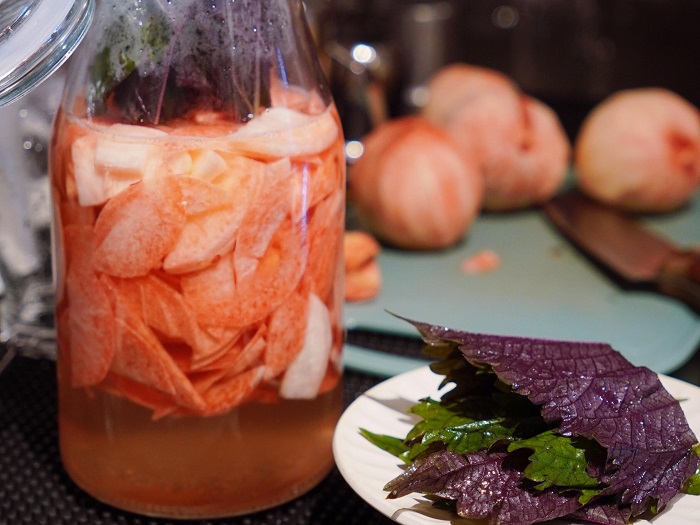
Why does the timing of flavor addition matter?
Kombucha is a living fermentation system.
During fermentation, yeasts and bacteria transform sugars and other components in the tea into organic acids, ethanol, carbon dioxide, and various flavor-active compounds.
When fruit, juice, herbs, or spices are introduced, they do not simply “sit” in the beverage. Their own chemical composition can interact with the existing fermentation.
Fruit and juice may add:
- fermentable sugars;
- organic acids;
- minerals;
- polyphenols;
- aromatic compounds.
Herbs and spices may contribute:
- essential oils;
- polyphenolic compounds;
- plant pigments;
- minerals;
- compounds with antimicrobial activity.
These additions can influence the microbial environment as well as the final sensory profile. Reviews of kombucha processing have found that changing the substrate and plant materials can affect fermentation behavior, physicochemical properties, and the characteristics of the finished beverage.
This is why flavoring should be considered a process variable rather than just a recipe ingredient.
Should fruit be added during primary fermentation?
Primary fermentation is the stage in which the kombucha culture transforms sweetened tea into the acidic fermented base.
Adding fruit or juice at this stage means the flavoring ingredient becomes part of the fermentation environment.
The fruit sugars may be consumed by the microorganisms, allowing fermentation-derived flavors to develop alongside the fruit character. Some fruit compounds may also be transformed by microbial activity, creating a more integrated flavor profile rather than simply adding fresh fruit flavor to an already-finished beverage.
However, there is a trade-off.
The additional sugars can increase microbial activity and change fermentation kinetics. The result may be a different acidification rate, residual sugar level, alcohol development, or carbonation potential.
This is particularly important for commercial producers trying to reproduce the same product across multiple batches.
A fruit puree, for example, can behave very differently from a clarified fruit juice. Particle content, sugar concentration, acidity, viscosity, and nutrient composition all influence how the addition behaves in the fermentation vessel.
For that reason, adding fruit during primary fermentation is better suited to a product concept in which the fruit is intentionally part of the fermentation itself.
It should not be treated simply as a convenient way to add flavor.
Why many producers flavor after primary fermentation
Adding fruit or juice after primary fermentation gives the producer much more separation between base fermentation and flavor development.
The kombucha base can first be fermented to its target specifications.
The producer can then evaluate:
- pH;
- acidity;
- residual sugar;
- fermentation time;
- aroma;
- flavor;
- appearance.
Once the base is ready, fruit, juice, herbs, or other flavoring ingredients can be added under more controlled conditions.
This approach has an important commercial advantage.
The fermentation endpoint can be established before the flavor ingredients introduce another set of variables.
The base can then be blended with a defined amount of flavoring ingredient according to a product formulation.
This makes it easier to reproduce a flavor profile across production batches.
For many commercial kombucha breweries, this separation is especially useful because different flavors can be developed from the same fermented kombucha base.
What happens during secondary fermentation?
Secondary fermentation or conditioning, is another common stage for introducing flavor.
At this point, the primary kombucha fermentation has already taken place, but active microorganisms may still remain in the beverage.
When fruit juice or another source of fermentable sugar is added, fermentation can continue.
This can create additional carbon dioxide if the beverage is subsequently held in a closed vessel.
This method can therefore combine:
Flavor development + additional fermentation + natural carbonation
However, the same biological activity that creates carbonation can also create process variation.
Fruit juice introduces additional fermentable substrate.
If yeast remains active, sugar may continue to be converted into fermentation products. Organic acids, ethanol, and carbon dioxide can continue to develop.
The amount and rate of change depend on the culture, ingredient composition, temperature, and conditioning period.
This means secondary fermentation should be monitored rather than treated as a passive flavoring stage.
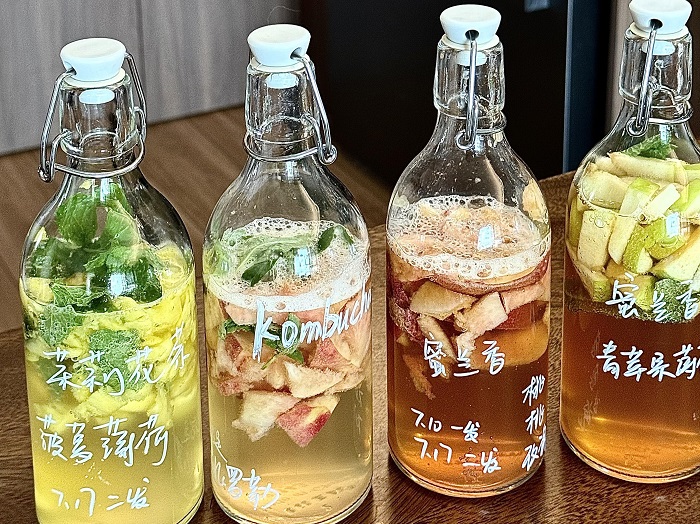
Should herbs be added at the same time as fruit?
Not always.
Fruit and juice are usually added primarily for their sugars, acids, color, and flavor compounds.
Herbs and spices can behave very differently.
Their most important flavor compounds may be volatile oils or other compounds that are sensitive to fermentation conditions.
Long exposure to an active fermentation environment can change the aroma profile.
Some plant materials may also contain compounds that affect microbial activity.
This does not mean that herbs should never be added during fermentation.
It means that the appropriate timing depends strongly on the ingredient.
For example, a producer looking for a subtle fermented botanical character may intentionally expose the herb to the kombucha culture for a defined period.
Another producer may want a fresher, more recognizable herbal aroma and therefore add the ingredient later, after primary fermentation.
Product trials are usually the best way to determine which approach delivers the desired result.
Fresh herbs, dried herbs, extracts or infusions?
The physical form of the flavoring ingredient also changes the process.
Fresh herbs
Fresh herbs can contribute delicate aromas and natural plant flavors, but they also introduce additional water, biological material, and variability in raw-material composition.
Handling and sanitation become important considerations.
Dried herbs
Dried herbs typically have a more concentrated composition and may provide a different extraction profile.
Their particle size and extraction characteristics can affect flavor intensity and filtration requirements.
Herbal extracts
Extracts can provide more precise dosing and may be easier to standardize at commercial scale.
However, the composition of commercial extracts can vary significantly depending on the extraction method and supplier.
Herbal or fruit infusions
Preparing an infusion separately allows the producer to control extraction before the flavoring material enters the main kombucha stream.
This can be useful when whole fruit or herb particles would create problems for pumping, filtration, or filling.
The choice should therefore be based not only on flavor but also on the requirements of the downstream equipment.
When should you add fruit puree?
Fruit puree is more difficult to handle than clarified juice.
It contains suspended solids and often has higher viscosity.
This can affect:
- mixing;
- pumping;
- filtration;
- heat transfer;
- sedimentation;
- filling.
For this reason, puree addition needs to be considered together with equipment design.
A tank capable of mixing a relatively thin kombucha base may not automatically be ideal for a high-pulp fruit formulation.
The producer should also decide whether the puree will remain in the final beverage or whether some level of clarification or filtration will follow.
If filtration is planned, the filtration system should be selected around the expected particle load.
Why sugar content matters after flavoring
One of the most important commercial considerations is that fruit and juice are not only flavoring ingredients.
They can also be significant sources of fermentable sugar.
A producer may formulate a flavored kombucha with a very specific target for sweetness, but the actual sugar contribution from fruit or juice can vary with:
- fruit variety;
- harvest conditions;
- processing;
- concentration;
- supplier;
- juice dilution;
- formulation ratio.
Adding the same volume of two different fruit juices does not necessarily add the same amount of fermentable sugar.
This is particularly important when the product will undergo secondary fermentation or natural carbonation.
A higher sugar load can support additional yeast activity, which can change both carbonation and alcohol development.
Commercial flavor formulations should therefore take the sugar contribution of the flavoring ingredient into account rather than treating it as an insignificant addition.
How does flavoring affect the microbial culture?
Flavor ingredients can change the fermentation environment because they introduce new nutrients and plant compounds.
Some fruits supply readily fermentable sugars.
Other ingredients contain antimicrobial or antioxidant compounds that may affect microbial activity.
The impact is ingredient-specific.
Scientific reviews of alternative kombucha substrates have reported that fruits, herbs, spices, and other plant materials can alter the chemical, sensory, and biological characteristics of the beverage.
This is one reason a successful flavoring formulation should be validated experimentally before it is transferred directly to large-scale production.
A formula that performs well with one fruit may not behave the same way with another.
Flavoring at commercial scale requires more than a mixing tank
As production volume increases, adding fruit, juice, or herbs becomes an equipment consideration.
A commercial flavoring system may need to handle:
- liquid or viscous ingredients;
- suspended solids;
- controlled dosing;
- sanitary mixing;
- temperature control;
- transfer to filtration;
- CIP;
- integration with carbonation and filling.
For liquid fruit juice, an accurate dosing and mixing system may be sufficient.
For puree or particulate ingredients, the tank design and pump selection become much more important.
The mixing system must distribute the flavor evenly without creating unnecessary shear, excessive foaming, or avoidable oxygen pickup.
Should you use a separate flavoring tank?
For commercial production, a separate flavoring or blending tank can provide significant flexibility.
You can use the primary fermentation tank for fermentation only.
Once fermentation reaches its target, the kombucha base can be transferred into a separate vessel where fruit, juice, herbs, or other flavoring ingredients are introduced.
This offers several benefits.
The fermentation tank becomes available for the next batch sooner.
Different flavors can be produced from the same kombucha base.
Flavor formulations can be adjusted without disturbing the primary fermentation.
The flavoring stage can be designed around mixing, dosing, filtration, carbonation, and filling requirements.
This type of separation becomes particularly useful for breweries producing several SKUs from one base kombucha.
How to keep flavor consistent from batch to batch
The hardest part of commercial flavoring is often not creating the first successful recipe.
It is reproducing it.
A flavor can change because the raw materials change.
The sugar concentration of fruit can vary.
The acidity of juice can vary.
The strength of an herb infusion can vary.
The fermentation endpoint of the kombucha base can vary.
Even mixing efficiency can change the final sensory profile.
For this reason, commercial producers can benefit from setting specifications for both the kombucha base and the flavoring materials.
Useful parameters may include:
- juice or puree concentration;
- soluble solids;
- pH;
- acidity;
- ingredient temperature;
- dosing percentage;
- mixing time;
- contact time;
- final carbonation;
- storage conditions.
The more precisely the input conditions are defined, the easier it becomes to reproduce the finished beverage.
Common flavoring mistakes in commercial kombucha
Adding fruit too early without adjusting the fermentation formula
Fruit contributes additional nutrients and sugars.
Adding it without accounting for those changes can alter the fermentation endpoint.
Adding Too Much Juice
More juice does not necessarily mean more flavor.
A large juice addition can shift sweetness, acidity, color, fermentation behavior, and carbonation.
Ignoring Ingredient Variability
Natural ingredients do not always have identical composition.
A formulation based only on volume may therefore produce different results over time.
Treating Herbs Like Juice
Herbs and spices can have very different extraction and microbial effects from fruit juice.
They may require a separate infusion or controlled contact stage.
Carbonating Before the Flavor Is Stable
If flavoring continues to change after carbonation, the final beverage may develop unexpected pressure or sensory changes.
This is particularly important when active fermentation remains after fruit or juice addition.
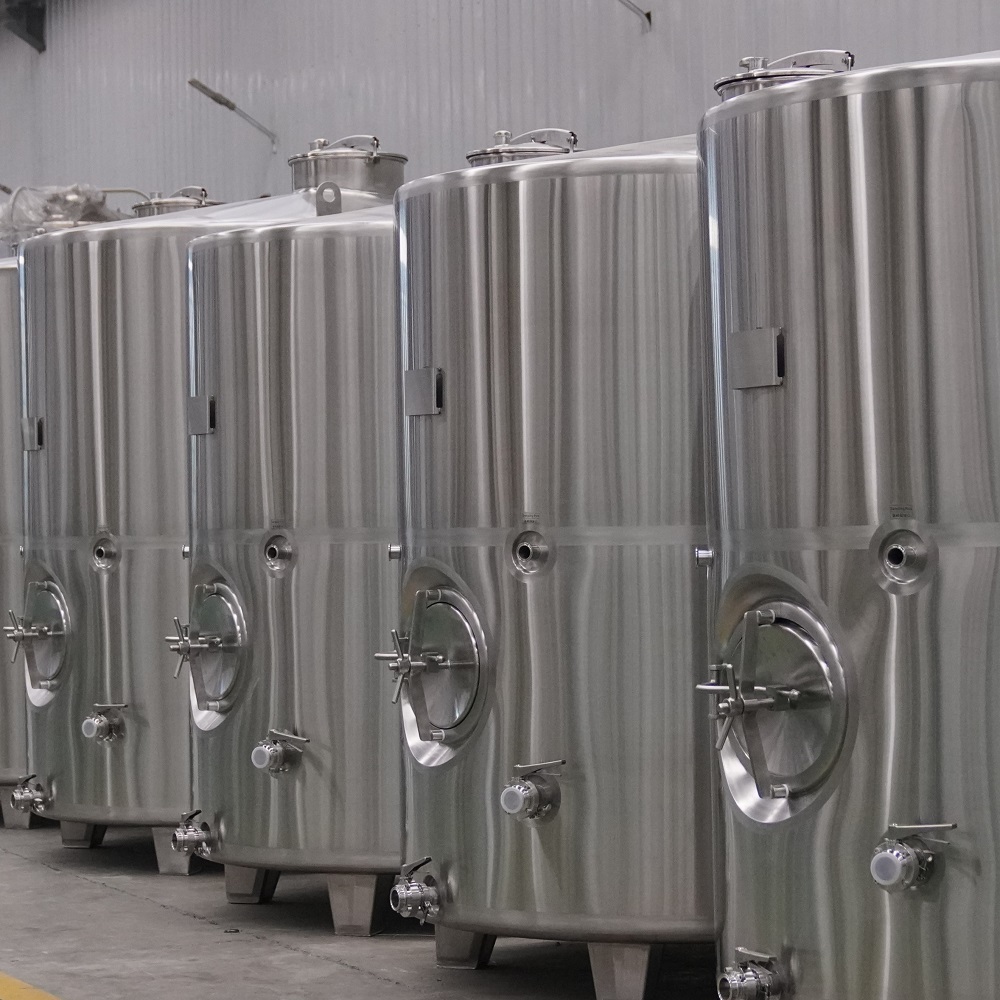
Designing a commercial kombucha flavoring system
Commercial flavoring is where beverage formulation and equipment design start to overlap.
A brewery may need a system capable of handling several different ingredient types, from thin fruit juices to viscous purees and particulate botanicals.
The equipment should therefore be selected according to the actual formulations.
Depending on the product range, a commercial system may include:
Blending or flavoring tank
For controlled addition and mixing of fruit, juice, herbs, or other ingredients.
Dosing system
For repeatable addition of liquid flavoring ingredients.
Agitation
For achieving uniform distribution throughout the batch.
Temperature control
Useful when ingredient temperature affects flavoring, mixing, or subsequent carbonation.
Sanitary transfer system
For moving flavored kombucha between tanks, filtration, carbonation, and filling.
CIP system
For removing sugars, fruit residues, and other organic material from product-contact surfaces.
Tiantai can configure kombucha processing systems around these requirements, integrating fermentation tanks with flavoring/blending, filtration, carbonation, and filling stages according to production volume and product formulation.